+86 13332949210
 info@xihobattery.com






 Xiho
Xiho Sep 10 2026
In the rapidly growing markets of residential energy storage, light electric vehicles, portable power stations and small commercial backup systems, 16kWh LiFePO4 battery pack and 32kWh energy storage battery pack have become two mainstream capacity options. Both are widely built with safe, long-cycle LiFePO4 chemistry, yet they differ significantly in energy storage capacity, physical size, upfront cost, backup runtime and suitable applications. This side by side comparison breaks down both configurations to help buyers make informed purchasing and deployment decisions.
Core Definition and Basic Performance
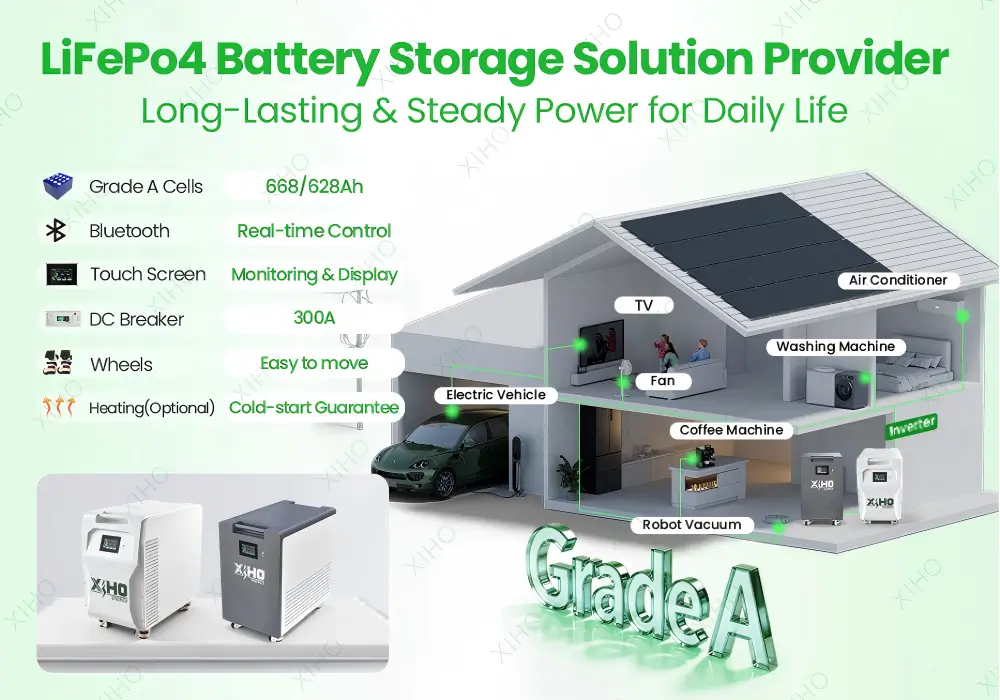
Kilowatt-hour (kWh) measures the total energy a battery can store and deliver. A 16kWh home solar battery pack stores 16 kilowatt-hours of electricity, while a 32kWh pack holds twice that amount. In most modular designs, 16kWh systems commonly use 51.2V nominal voltage paired with around 314Ah capacity, and 32kWh systems often run on the same 51.2V voltage platform with approximately 628Ah cells or two parallel connected 16kWh modules.
Both battery sizes support similar charge discharge rates and are compatible with grid tie, off grid and hybrid solar inverters. However, the 32kWh version typically delivers higher continuous output current. This enables it to run high power loads such as air conditioners, electric water heaters, heavy duty power tools and home EV chargers without noticeable voltage drop. For cycle life, under 80% depth of discharge (DoD), both LiFePO4 packs can achieve over 6,000 cycles. With proper maintenance, they can serve homes and businesses reliably for 10 to 15 years.
Physical Size, Weight and Installation
Space and weight are critical constraints for installation and mobility.
16kWh Battery Pack Installation Features
16kWh Battery Pack Installation Features
A typical 16kWh off grid battery pack weighs about 120kg with compact outer dimensions. It can fit easily inside home utility rooms, balconies or small equipment compartments. Many 16kWh units come with built in casters for flexible movement, supporting both wall mounted and floor standing installation styles.
32kWh Battery Pack Installation Features
32kWh Battery Pack Installation Features
By contrast, a 32kWh battery pack has roughly double the volume and weight, usually around 240kg or heavier. It requires dedicated floor space, stronger floor load bearing capacity and thoughtful ventilation planning. Some 32kWh models retain stackable modular design, but they are not easy to move around. They are best suited for permanent fixed installation instead of frequent relocation.
Cost and Economic Efficiency
Upfront purchase cost is one of the biggest factors for buyers.
Cost Profile of 16kWh Battery Systems
Cost Profile of 16kWh Battery Systems
A 16kWh Grade A LiFePO4 battery pack comes with a much lower upfront price tag, cheaper installation fees and fewer wiring upgrade requirements. It works perfectly for buyers with a limited budget who want to set up solar energy storage without heavy capital investment.
Cost Profile of 32kWh Battery Systems
A 32kWh system demands higher initial investment, but its cost per kWh is often lower thanks to economies of scale. In long term operation, it reduces daily charging cycle frequency, cuts average energy expenses and improves solar panel self consumption rate. For users with high power demand, picking a 32kWh pack avoids adding multiple small battery units later, saving extra component costs, labor fees and system complexity.
Runtime and Application Scenarios
Runtime and Application Scenarios
The clearest difference between these two batteries lies in backup duration and load support capability.
Best Use Cases for 16kWh Battery Packs
A 16kWh battery is suitable for:
- Small to medium households running essential loads including lighting, routers, refrigerators and fans
- Short term backup power during brief grid blackouts
- Small solar storage systems for daily peak load shifting
- Portable industrial and construction power supplies
- Light electric vehicles and compact marine power systems
It provides affordable energy for basic daily needs, but may struggle to sustain high power appliances over long periods or support full house loads during extended power outages.
Best Use Cases for 32kWh Battery Packs
A 32kWh battery pack excels in high demand scenarios:
- Large family homes and villas running full home loads including HVAC systems
- Long term off grid living in locations with frequent prolonged outages or weak sunlight
- Small retail shops, workshops and farm facilities needing stable backup power
- Home EV charging equipment and other energy intensive machinery
- Expandable energy hubs that may add more power loads in future
With double the energy capacity, it delivers longer backup runtime, higher continuous power output and better resilience against extreme weather and unstable power grids.
Advantages and Limitations
Advantages and Limitations
Pros and Cons of 16kWh LiFePO4 Battery Pack
Pros and Cons of 32kWh LiFePO4 Battery Pack
How to Choose Between 16kWh and 32kWh Battery Packs
Use these key factors to make your final decision:
- Daily energy demand: Calculate your daily power consumption. If daily usage stays under 10–15kWh, 16kWh is sufficient. If consumption exceeds 15kWh per day, select 32kWh.
- Backup time requirement: Pick 16kWh for short power outages lasting a few hours. Choose 32kWh for half day or full day continuous backup.
- Available space and mobility needs: Limited installation space or frequent movement requirements favor 16kWh modular solar battery pack. Fixed permanent installation can accommodate the larger 32kWh unit.
- Project budget: Buyers with tight budgets can start with 16kWh. Those looking for long term energy investment and full home backup should consider 32kWh.
- Future system expansion: If you plan to add more electrical loads later, 32kWh leaves extra power headroom for upgrades.
Conclusion
16kWh and 32kWh battery packs are designed for different user requirements, and neither option is universally better than the other. The 16kWh residential energy storage battery pack serves as a cost effective compact entry solution for small households and basic backup needs. The 32kWh pack is a heavy duty high capacity option for extended runtime, high power demand and greater energy independence. Evaluate your daily power consumption, installation environment, budget and long term plans to select the right battery capacity to balance performance, cost and convenience for your energy storage or mobile power project.
Inquiry more product details from the : Lithium Ion Battery Manufacturers
WhatsApp/Wechat/Mobile: +86 13332949210
Email: info@xihobattery.com
Website: www.xihopower.com